Telephone 01525 719588
Email constantia@uwclub.net
Structural & Autonomic Medicine
The body is designed to be healthy and health is the normal state – the body becomes sick from misuse, overexertion, neglect, wrong lifestyle and diet, use of vaccines and pharmaceutical drugs, and it has its own built in mechanisms to heal itself. The body is always replenishing and repairing itself on a daily basis but it needs to be supplied with adequate rest and nutrition to accomplish this.
If the abuse to the body exceeds the capacity of its self-repair mechanisms then it needs a helping hand – a gentle nudge – to get back to health (not a chemical sledgehammer to suppress the symptoms)
There is an invisible and friendly “Intelligence” that formed the body in all its complexity and maintains health and the true physician works in harmony with this intelligence which desires you to be in a better state of health and does not attempt to coerce the body in anyway.
In particular the body has all the chemicals it needs and will ever need and no synthetic chemicals are needed except anaesthetics and anti-septics.
Disease in the physical body begins with disturbance in the autonomic nervous system and its connection with the hypothalamus and pituitary gland and the higher centres in the brain. The disturbances in the autonomic and endocrine systems very often have their cause in disturbances in the etheric body. In reality there are no “conditions” or “diseases” – these are artificial constructs which are convenient for a mainstream “healthcare” system based upon a commercial and ideological monopoly. In reality there are only obstructions to normal healthy function caused by physical and mental trauma, external mechanical forces, faulty posture, diet, lifestyle and self-limiting beliefs.
The body communicates through the modality of sensation – ie pain, discomfort, restriction – to bring to your attention that something is wrong. Every experience is stored in the body tissues. The physician, using skill of palpation, “reads” the story of the tissues.
Back pain – some back pain is of ligamentous origin – strained ligaments – ligaments are bands of tough fibrous connective tissue which hold the joints together. Ligaments are commonly strained through faulty posture. When a ligament is strained the brain receives messages through the proprioceptive system that the joint is unstable and the brain then sends messages to the muscles around the joint to contract to keep the joint stable – hence the muscle spasm, acheing and pain. To solve the problem the ligamentous tension has to be rebalanced, restore the stability of the joint and remove the need for the muscle spasm. Back pain is miserable and draining because it takes a lot of energy from the body to supply the muscles that contract to keep a joint stable when the ligaments have been strained.
However the commonest cause of back pain is due to overload of the sympathetic division of the autonomic nervouse system and pain is referred to the nervous pathways that supply the spinal muscle to spare the internal organs innervated by that segment of the spinal cord. Emotional stress caused by life events such as divorce, bereavement, house move etc can cause back and neck pain as the nervous system becomes overworked and gets locked into a chronic excitatory pattern due to worry. This sort of back pain can only be releived by calming down the sympathetic tone and the traffic in the hypothalamic-spinal pathways.
Other causes of back pain are kidney disease, pancreatic disease, primary bone neoplastic (cancer) disease, bone fracture, bowel neoplastic disease, duodenal or gastric ulcer, side-effects of statins, to mention a few. Also disturbances in any of the chakras can lead to disturbances to the internal organs and to musculoskeletal pain.
Neck pain – common causes of neck pain are postural but also lymphadenopathy, meningitis
Whiplash – is a whole body trauma – not just the neck or the spine. A whiplash injury – commonly resulting from a car accident – affects all the body fascias, the internal organs, the endocrine system as the dura mater is stretched. If the fascial and dural stretch is not addressed soon after the accident then it can cause long term mental, emotional and hormonal effects (for example it can disrupt the menstrual cycle) which may not manifest until weeks or months after the initial injury.
Arm/leg pain, numbness, pins and needles – commonly caused by nerve root entrapment but there are other causes such as diabetes, thyroid disorders, side-effects of prescription drugs. Sciatica – irritation of the sciatic nerve is usually caused by the piriformis muscle contracting because the sacroiliac ligaments are strained – the sciatic nerve runs through the belly of the piriformis muscle but there are other causes of sciatica such as a neurofibroma. Tendonitis is inflammation of the tendons cause be repeated contraction through overuse.
Dysmenorrhoea or period pain – can be due to stagnation or congestion in the pelvic area, torsion of the uterus.
Problems after childbirth – a difficult labour and delivery eg the baby getting stuck in the mothers pelvis can upset the ligaments and fascias and particularly the dura mater where it attaches at the tip of the coccyx – the dura mater also attaches at C2 vertebra and inside the front of the skull – it can upset the hormones, the thyroid, the hypothalamus, the pituitary and is a common cause of post-natal depression. In ayurvedic medicine terms apana vata can get derranged and move upwards and disrupt the whole physiology – if apana is disturbed or blocked it can derrange prana vata and cause mental/emotional problems – hence post-natal “depression” and also PMT. See Ayurveda page and scroll down to Subdoshas, Apana.
Migraine – more common in women and commonly asociated with the menstrual cycle. The primary cause is usually a torsion in the pelvis and uterus.
Sinus problems – can be due to bony misalignments in the skull caused by injury, unreleased compression of the cranium during birth, overload of the liver, gut dysbiosis or candidiasis eg caused by overuse of antibiotics
Jaw problems – pain, clicking – caused by strain of the ligaments of the temporomandibular joint by prolonged dental work
Eczema, acne – can be due to allergy or can be due to poor elimination from other channels such as constipation, poor lymphatic drainage, sluggish liver, prolonged regular use of antiperspirants.
Mild asthma in adults and asthma in children – usually caused by a restriction in the upper ribs which can be released by
Haemorrhoids or piles – caused by venous stasis and/or back pressure in the hepatic portal circulation
General ill health – improve the overall health by improving aterial and venous circulation, lymphatic drainage and normalising the function of the nervous system especially autonomic function (scroll down for details of the autonomic nervous system), integrating the higher centres in the brain with hypothalamic function and endocrine function.
Why the spine is important
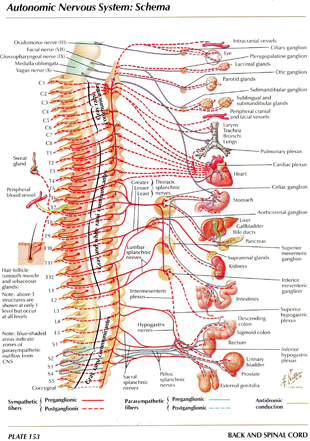
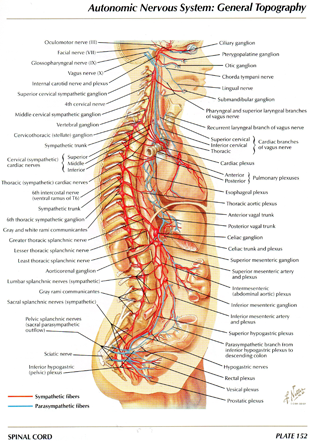
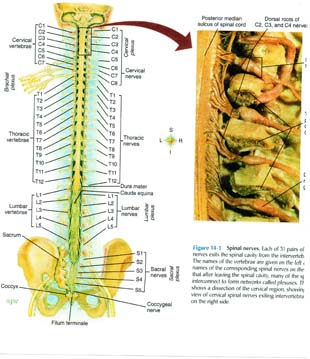
The vertebral column houses and protects the spinal cord. The spinal cord is like a telephone exchange between the brain and the rest of the body. Nerve fibres that enter the spinal cord relay messages to the brain about what is going on in the body and nerve fibres that leave the brain and travel down the spinal cord send “instructions” to the blood circulation and all the internal organs, muscles, glands etc. The following diagrams are taken from Atlas of Anatomy by Frank Netter:-
Recurrent tonsilitis – the tonsils are a ring of lymphatic tissue which guard the back of the throat and act as a sentry guard to the body since the mouth is obviously a major opening of the body for foreign materials to get inside the body – the tonsils have a very important protective function in that they filter out any harmful substances we may ingest. recurrent tonsilitis can occur because either the blood supply or the nerve supply is comrpomised and the tonsillar tissue itself is weakened or that we are ingesting something on a regular basis which is fatiguing the tonsils. Consider whether there was anything in the diet which the body may be trying to reject. In contrast the allopathic approach is to give antibiotics every time there is an episode of tonsilitis and if the episodes continue to surgically remove the tonsils. Firstly repeated courses of antibiotics will not cure the problems because the problem is not the bacteria – the problem is with the tonsils or something the patient is ingesting. Moreover the repeated courses of antibiotics can disturb the balance of the intestinal flora and result in candidiasis. Surgical removal of the tonsils results in the removal of the protection of the immune system at the back of the throat and then the next level of protection is the patches of lymphatic tissue that are in the lining of the gut which means that the symptoms move from the back of the throat to the gut which manifests as what we call “irritable bowel syndrome”. So the original problem is not cured and there is a new and worse problem to deal with.
Dysmenorrhoea (very painful periods) – the doctor will usually prescribe contraceptive pills to “normalise the periods” – this is not investigating and curing the cause of the painful periods this is giving an artificial hormone (which has side-effects which cause further probelms) to superimpose an artificial sense that all is well when in fact the pathology is still continuing unabated and getting worse- therefore with allopathic medicine you have the original disease still uncured plus a new disease caused by the side-effects of the contraceptive pill. Dysmenorrhoea is often due to a twisted pelvis which results in a twisted uterus or a stain in the ligaments of the pelvic bowl.
The autonomic nervous system
The autonomic nervous system is that part of the nervous system that controls and regulates the bodily functions which we are not normally aware of. It has two divisions: sympathetic and parasympathetic.
The sympathetic division is responsible for moblisation of the body`s resources for the “fight or flight” response. It is important to survival in a situation of serious acute threat. Nerve impulses in the sympathetic division causes blood to be diverted away from the gut to the heart, skeletal muscle and the brain.
The parasympathetic division is responsible for assimilation of nutrients and relaxation, recuperation and repair after the sympatheti division has been activated in a situation of danger. Nerve impulses in the parasympathetic divison causes blood to be diverted away from the brain and skeletal muscle and to the gut (which is why you feel lethargic and sleepy after a big meal).
In a natural setting it would enable us to act appropriately if for example we were threatened by a tiger – and if we escaped the tiger and got to safety the parasympathetic division would then retsore our system back to what it was before. In our society we don`t have tigers we have bank managers – we can`t run away or fight in a physical sense – it is an everpresent threat and also we have no “down time” where the parasympathetic division can carry out repair easily. Thus we end up in a situation of chronic sympathetic hyperarousal where there is an imbalance in the distribution of blood in the different parts of the body – some parts not receiving adequate supply of blood – and this is the seed of disaese. Hence there is a high incidence of high blood pressure, diabetes, iritable bowel, high cholesterol levels etc. Doctors prescribe drugs to lower the blood pressure, cholesterol etc but this only creates an artificial sense of these parameters being “nomal” – it just masks the fact that the whole system is out of balance and the imbalance gets worse as often no lifestyle changes are made to resore the system to health. Moreover doctors espouse that diseases are caused by infections whereas it is compromised and diseased tissues which provide the soil for bacteria to flourish.
By reducing the “sympathetic tone” of the tissues and restoring balance in the autonomic nervous system removes the very basis of disease. The sympathetic nerve trunks exit the spinal cord along the thoracic and lumbar spine.
| The Autonomic Nervous System | ||
| Structure | Sympathetic Stimulation | Parasympathetic Stimulation |
| Iris (eye muscle) | Pupil dilation | Pupil constriction |
| Salivary Glands | Saliva production reduced | Saliva production increased |
| Oral/Nasal Mucosa | Mucus production reduced | Mucus production increased |
| Heart | Heart rate and force increased | Heart rate and force decreased |
| Lung | Bronchial muscle relaxed | Bronchial muscle contracted |
| Stomach | Peristalsis reduced | Gastric juice secreted; motility increased |
| Small Intestine | Motility reduced | Digestion increased |
| Large Intestine | Motility reduced | Secretions and motility increased |
| Liver | Increased conversion of glycogen to glucose |
|
| Kidney | ||